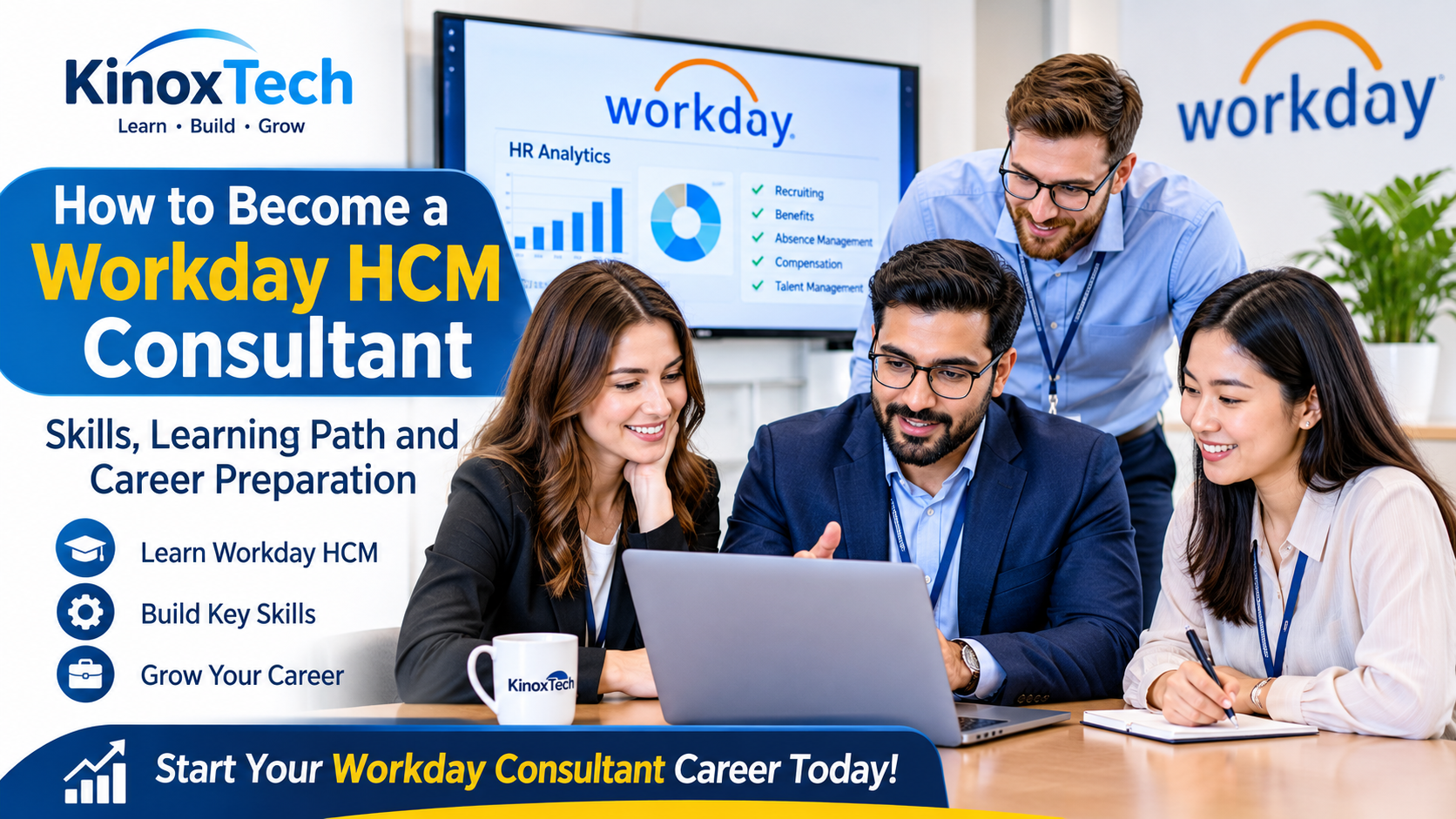
How to Become a Workday HCM Consultant: Skills, Learning Path and Career Preparation
Workday HCM is an important cloud-based human capital management platform used by organizations to manage workforce information, HR processes and employee-related activities. As businesses modernize their HR operations, professionals with knowledge of HR systems, business processes and Workday concepts may find opportunities in HR technology and consulting.
If you want to become a Workday HCM consultant, you need more than software knowledge. You should understand human resources, organizational structures, business workflows, reporting, security concepts and how technology supports business requirements.
This guide explains the skills, learning path and career preparation that can help beginners and experienced HR professionals work towards a Workday HCM consulting career.
1. What Does a Workday HCM Consultant Do?
A Workday HCM consultant helps organizations understand, configure, implement, support or improve their Workday Human Capital Management processes. You can explore the official Workday HCM product overview for a product-level introduction.
Depending on the role and project, responsibilities may include:
- Understanding HR and workforce management requirements.
- Working with organizational structures and employee data.
- Understanding Workday business processes and approval workflows.
- Supporting testing and implementation activities.
- Reviewing security roles and access requirements.
- Helping with reports and data validation.
- Supporting HR teams during system changes.
- Preparing documentation and training materials.
The exact responsibilities depend on the employer, project and consultant’s experience.
2. Learn the Fundamentals of Human Resources
Before learning Workday functionality, understand the HR processes that the software supports.
Important concepts include:
- Employee lifecycle management.
- Recruitment and hiring.
- Onboarding.
- Job changes and promotions.
- Compensation and benefits.
- Absence and leave management.
- Performance management.
- Employee termination.
- Organizational management.
Understanding these processes makes it easier to understand why a business uses particular system workflows.
3. Understand the Main Workday HCM Modules
A beginner should become familiar with the main areas of Workday HCM.
Core HCM
Core HCM supports worker information, job details, organizational structures and employment-related data.
Workday Recruiting
Recruiting supports recruitment activities, candidate management and hiring workflows.
Workday Onboarding
Onboarding helps organizations manage activities and information required when new employees join.
Workday Absence Management
This area supports leave and absence processes, including applicable policies and approvals.
Workday Benefits
Benefits functionality helps organizations manage employee benefit plans and related enrollment processes.
Workday Compensation
Compensation supports salary and compensation-related processes.
Workday Talent and Performance
These areas support employee development, performance reviews and talent-related activities.
Workday Reporting and Analytics
Reporting helps organizations access and analyze workforce and HR information.
For a broader introduction, read the KinoxTech Workday HCM Training and Learning Guide. You can also review our beginner-friendly article explaining the main Workday HCM modules.
4. Develop Essential Workday Consultant Skills
Successful consultants combine functional knowledge with analytical and communication skills.
Functional skills
- HR and HCM fundamentals.
- Workday module concepts.
- Business process understanding.
- Organizational management.
- Employee lifecycle knowledge.
Technical and analytical skills
- Reporting fundamentals.
- Data analysis and validation.
- Spreadsheet skills.
- Understanding integrations at a conceptual level.
- Testing and troubleshooting.
- Security and access concepts.
Professional skills
- Communication with stakeholders.
- Problem-solving.
- Requirements gathering.
- Documentation.
- Team collaboration.
- Time management.
You do not need to master every technical area before starting. Build your knowledge gradually.
5. Follow a Step-by-Step Workday HCM Learning Path
A structured learning plan can help you build knowledge without becoming overwhelmed.
Step 1: Understand HR fundamentals
Learn employee lifecycle processes, recruitment, compensation, benefits and organizational structures.
Step 2: Study Workday HCM concepts
Explore Core HCM, Recruiting, Onboarding, Absence, Benefits and Compensation.
Step 3: Learn business processes
Understand how workflows, approvals, conditions, notifications and security permissions support HR activities.
Step 4: Study reporting concepts
Learn the purpose of reports, calculated fields and workforce analytics. Progress to practical exercises when you have legitimate access to a learning environment.
Step 5: Understand testing and implementation
Study requirements gathering, test scenarios, data validation, issue documentation and user acceptance testing.
Step 6: Prepare for interviews
Practise explaining HCM concepts, business workflows and real-world HR scenarios.
6. Build Practical Experience
Practical knowledge is valuable when applying for consulting roles.
You can build experience through reviewing legitimate product documentation, including Workday’s HCM Administrator Guide, alongside the activities below:
- HRIS or HR operations experience.
- Work on HR process documentation.
- Practice creating business process flow diagrams.
- Sample requirements documents.
- Test scenarios and test case writing.
- Reporting and spreadsheet exercises.
- Legitimately available Workday training or demonstration environments.
Do not claim hands-on Workday implementation experience if you have only studied the concepts. Clearly distinguish training, simulations and professional project experience.
7. Understand Workday Training and Certification
Workday’s official training and certification opportunities may have eligibility, employer or partner access requirements. Availability and costs can vary. Review Workday training and certification information directly before enrolling.
Before paying for a course or certification, review the official Workday training and certification information and verify:
- Whether the training is officially provided or authorized.
- Whether it includes practical system access.
- What learning materials are included.
- Whether the certification is officially recognized by Workday.
- Whether the advertised cost covers training, examination or both.
Avoid assuming that completing an independent online course automatically makes someone an officially Workday-certified consultant.
8. Workday HCM Consultant Career Opportunities
Workday-related career paths may include:
- Workday HCM Analyst.
- Workday Functional Consultant.
- Workday HRIS Analyst.
- Workday Recruiting Consultant.
- Workday Compensation Analyst.
- Workday Absence Management Specialist.
- Workday Reporting Analyst.
- Workday Implementation Consultant.
Job titles and requirements differ between employers. Some positions require prior implementation experience, while others may focus on HR operations, support or junior analyst responsibilities.
Opportunities in the USA
Explore roles involving Workday HCM, HRIS, implementation support and functional consulting. Review individual job descriptions for experience, location and work authorization requirements.
Opportunities in the UK
Look for Workday HCM analyst, HRIS and functional consulting roles. Pay attention to UK employment terminology, employer requirements and location-specific eligibility.
Opportunities in Canada
Research Workday analyst, HR technology and implementation-related positions. Review requirements for Canadian work authorization, experience and local employment conditions.
These are career research directions, not guarantees of job availability.
9. How to Prepare for a Workday HCM Consultant Interview
Prepare to explain:
- What is Workday HCM?
- What is Core HCM?
- What is the employee lifecycle?
- What are Workday business processes?
- What is organizational management?
- What is Workday Recruiting?
- What is Absence Management?
- What is the purpose of Workday reporting?
- Why is security important in HR systems?
- How would you approach testing an HR workflow?
Read our Top 50 Workday Interview Questions and Answers for further preparation.
You can also explore our Oracle vs Workday comparison to understand the differences between two major enterprise software platforms.
10. Common Mistakes Beginners Should Avoid
- Trying to learn every Workday module at once.
- Ignoring HR and business process fundamentals.
- Memorizing interview answers without understanding concepts.
- Paying for training without verifying its credibility.
- Claiming official certification without earning it.
- Confusing theoretical knowledge with implementation experience.
- Applying for senior consulting roles without meeting their experience requirements.
Focus on building a strong foundation first.
Frequently Asked Questions
1. How can a beginner become a Workday HCM consultant?
Start with HR fundamentals, learn Workday HCM concepts, understand business processes, study reporting and security basics, and develop practical experience through legitimate learning opportunities.
2. Do I need an HR background to learn Workday HCM?
An HR background can be helpful, but it is not the only route. People from IT, business analysis, finance and other professional backgrounds may also develop relevant skills.
3. Is Workday HCM difficult to learn?
The difficulty depends on your previous experience and learning approach. Beginners should start with HR concepts and Core HCM before moving into advanced areas.
4. Can I become a Workday consultant without certification?
Some employers may consider candidates based on relevant experience and skills, while other roles may require specific credentials or access to official training. Check each employer’s requirements.
5. What skills are important for a Workday functional consultant?
HR knowledge, business process understanding, requirements gathering, communication, documentation, testing and analytical skills are all valuable.
6. Are there Workday HCM career opportunities in the USA, UK and Canada?
Workday-related roles exist in different markets, but availability and eligibility depend on employers, location, experience and current hiring needs.
Conclusion
Becoming a Workday HCM consultant requires a combination of HR knowledge, functional understanding, analytical ability and professional communication.
Start with Core HCM and employee lifecycle concepts, learn the major modules, understand business processes and gradually develop reporting, testing and implementation knowledge.
Explore the KinoxTech Workday HCM learning guide to continue building your knowledge and prepare for your next step in HR technology.
KinoxTech — Learn, Build and Grow.
